Jobber
Overview
Two-way text messaging launched as an MVP on desktop. This project addressed the gaps that emerged once real usage data and feedback came in, particularly from field-workers (including admins), who made up a significant share of Jobber's customer base.
Problem
The MVP left critical gaps
01
Limited accessibility
The initial rollout was desktop-only, causing admins to miss client messages while in the field
02
Restricted access
Only admins could view the messaging feature, leaving field workers unable to see responses to messages they initiated
03
Lack of notifications
The only notification was a desktop badge. No push alerts, which was especially problematic for mobile users in the field.
Design Principles
01
Familiarity
Use familiar patterns and best practices consistent with users' mental models to ensure ease of use.
02
Easy context switching
Facilitate seamless transition between messaging and other product areas, allowing reference to relevant information without disruption.
03
Work preservation
Ensure that work in progress (e.g. composing a message) is retained to eliminate concerns about losing information during context switching.
Designs
Flexible permissions
Previously tied to admin accounts only. We introduced flexible permissions so Jobber account administrators could allow team members to manage text messages, while keeping administrator-level information private. This let customers and field workers communicate directly, without an admin having to relay the message to them.

Messaging in the mobile app
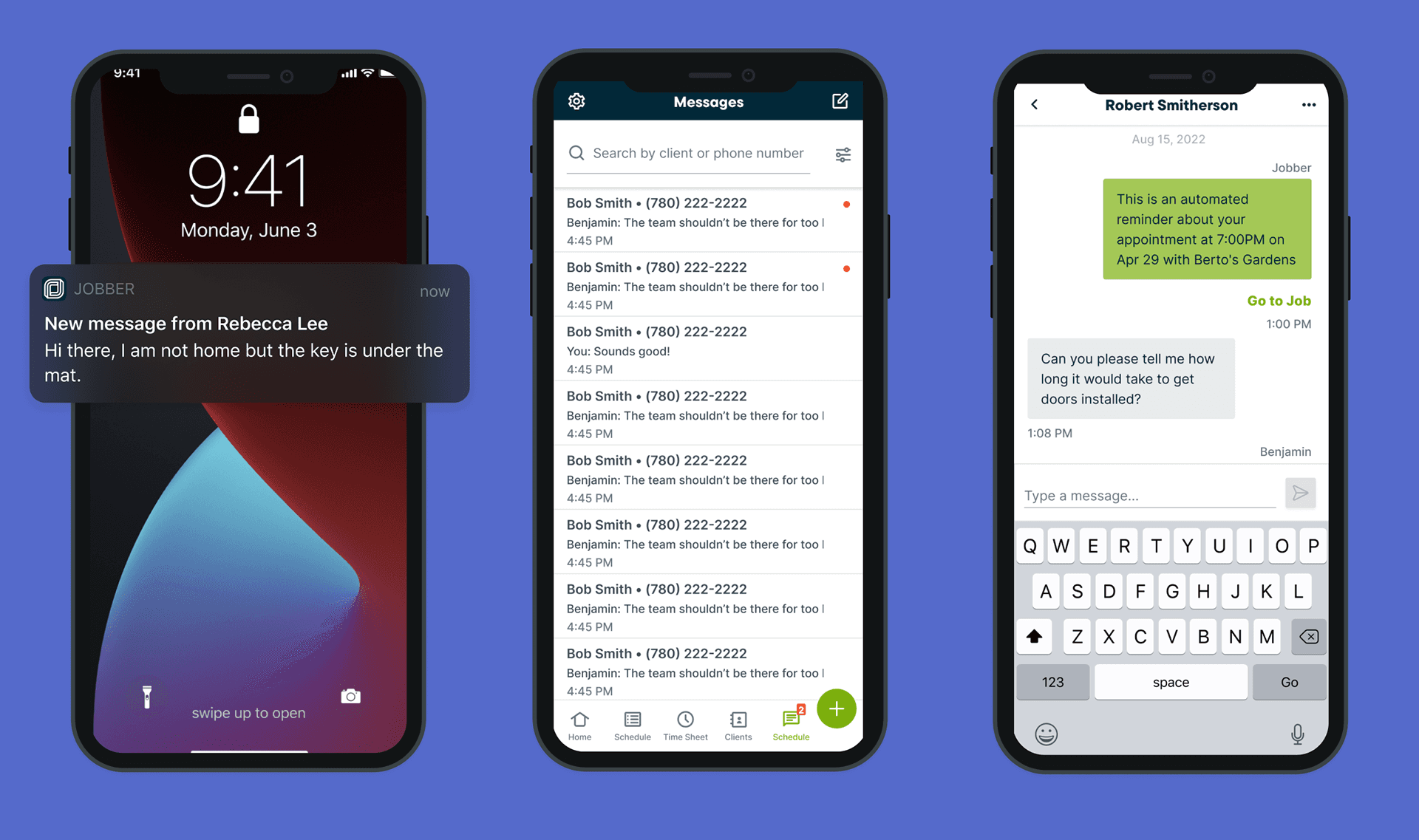
We introduced messages in the app as part of the main navigation so service providers could get notified of new messages and respond without being at a desktop. Push notifications took providers directly into the app, and messages synced in real-time between mobile and desktop. This closed the gap for the many providers managing their business entirely from their phone.

Search and conversation management
As conversation volume grew, users found themselves scrolling extensively to locate specific or unread messages. This was particularly frustrating for providers managing messages across many clients. We added search by client name or phone number, along with the ability to mark conversations as unread and filter by unread status. Search and filtering worked in combination, so businesses could quickly narrow down to exactly what needed a response.


New message composition
In the first iteration of two-way text messaging, there was no way to freely compose a message to a new client or phone number unless previous communications had been sent through Jobber. This was a major pain point. Providers wanted to reach out to leads before sending a quote. We introduced a composition flow allowing providers to send to any client or phone number.

The little things
Over time, we gradually introduced smaller tweaks based on additional feedback:
Updated styling of new chat components to use more accessible colours
Updated messages from relative to absolute timestamps for more clarity
Updated messaging views to consume new global typography styles
Provided a quick way to access the client's profile from the conversation
Grouped chat bubbles sent in succession (within a short time frame) to clean up timestamp labels
Forwarded calls received on the dedicated messaging number to the company phone number

Notes
Platform thinking compounds
This project reinforced the value of building flexible, permission-based systems early. By architecting messaging for team use (not just admin use) we unlocked a larger surface for communication improvements downstream.
It also showed the importance of treating "fast follows" as first-class features. Open text messaging and unread filtering were initially scoped out, but user feedback made clear they were essential to adoption. Shipping the MVP and returning quickly was more effective than holding launch for completeness.
Impact
Stronger retention and repeat business
Our goal was to give field workers the same access to client conversations that desktop users already had, without sacrificing the speed admins needed to respond. The numbers suggest we closed that gap.
For service providers using two-way text messaging, we saw:
A 3x reduction in account churn rates compared to non-users.
A 2x increase in returning customers compared to non-users.
We also saw an early signal of improved quote win rates, though the sample size was too small to draw strong conclusions…a good next area to track as adoption grows.
"Previously when we would text a client that conversation was "trapped" on the individual's cell phone. Now that Jobber has 2-way texting our client communication and the professional business image are going to skyrocket. No more lost leads or clients accidentally messaging an employee's cell phone"
— Service provider